
I pulled up at Divisional Command and got the briefing. Our division was about thirty-eight kilometres long and we had seven trucks to cover it. “Seven trucks for thirty-eight k’s? That’s stretching it thin.” It was. That was what we had. You can’t put a truck on every hundred metres of fire edge so you don’t try. You work out where the fire does the most damage if it gets through and you put your trucks there. Everywhere else you watch, you flank or you accept the risk.
That’s resource allocation in a crisis. It isn’t a spreadsheet exercise, it’s deciding what you’re going to save when you can’t save everything.
07:15 Wednesday: four people, three “critical” functions
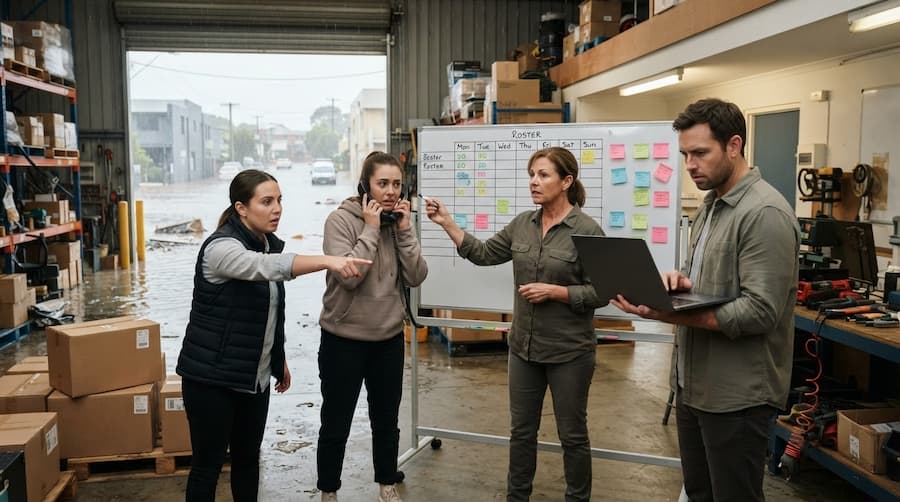
A flood has cut the main road overnight. It’s 07:15 on Wednesday and four of your eleven staff can get in, which isn’t unusual. At the peak of the March 2022 floods in NSW and Queensland the ABS found more than half a million Australians worked fewer hours than usual because of bad weather. Your roster is a casualty too, not just your building.
Sales says they’re critical because there are deals closing this week. Customer service says they’re critical because the phones are already ringing. Dispatch says they’re critical because orders went out the door yesterday and more are due today. Your loudest customer is already on the line wanting to know where their stuff is. You’ve got enough people to properly staff one function. Which one?
Why everything gets labelled essential
Ask any team leader if their area is critical and they’ll say yes. They’re not lying. From where they sit it is critical. Trouble is, when everything is essential nothing is. You end up spreading four people across three jobs so thinly that none of them get done.
There are two traps here. The first is the visible problem versus the dangerous one. On the fireground the bit of fire you can see from the road isn’t always the bit that will hurt you. The dangerous section is often the one running quietly up a gully towards houses. In business the ringing phone is visible, while the orders that silently don’t ship are dangerous.
The second trap is the loudest stakeholder. That customer on the phone feels like the most urgent thing in your day because they’re in your ear. They might be, or they might just be the loudest. Fear makes people do irrational things and one of them is giving all your attention to whoever is shouting.
Resource allocation: find your 20%
Most of what your business does can pause for a few days without real harm. A small part of it can’t. That small part is what I call your 20%. In my experience it comes down to three things.
The first is keeping cash coming in. If money stops arriving the crisis gets longer and more expensive. The second is keeping promises to customers. Orders already paid for and commitments already made are where trust gets won or lost. The third is keeping people safe, which isn’t negotiable. It sits above the other two.
This is what people call a minimum viable operation. It’s the smallest version of your business that still pays the bills, keeps its word and doesn’t put anyone at risk. Your business continuity plan should name it in writing before you ever need it. Don’t assume insurance will carry you through. After the 2022 Lismore floods 89.8% of businesses in the council’s impact survey had no flood insurance at all, so recovery came out of their own pockets.
Fight It, Flank It or Let It Burn
Here’s how I’d allocate resources on Wednesday.
Fight it: dispatch. Orders going out is cash coming in and promises being kept. That’s two of your three tests in one function, so put your best people on it and make sure every committed order leaves the building today.
Flank it: customer service. You can’t staff the phones properly but you don’t have to leave customers in the dark. Record one clear voicemail message explaining the flood and when you’ll call back, then send one SMS to all customers saying the same thing. Twenty minutes of work stops the fire spreading into a flood of angry calls.
Let it burn: the sales pipeline. It hurts to say it but new deals can wait a week. Prospects will understand a flood, so tell them you’ll be in touch next week and mean it. Letting something burn is a decision you make on purpose, which isn’t the same as forgetting about it.
The 15-minute Business Fire Drill
Get your team in a room, set a timer for 15 minutes and talk through these four questions out loud.
- If only four people turn up tomorrow, which jobs actually happen?
- Which function stops costing us money if it pauses for a week?
- Who makes the call on what gets saved? Has everyone agreed to that in advance?
- What will we deliberately let fail? Who tells the people affected?
If the room goes quiet on any of these you’ve found the gap. Write it down, give someone a date and then go back and test it again. That’s the DADA process at work.
Make the hard choice before the crisis makes it for you
Small fires left alone to burn quickly turn into large fires, yet trying to fight every small fire at once is how you lose the big one. The skill isn’t working harder, it’s choosing.
On that division we didn’t get more trucks, we just got clearer about where the seven we had would do the most good. Your business will face its own version of that briefing one day, so have the conversation now while it’s calm and you’ll make better calls when it isn’t.
Run this drill with your team this week. Want it facilitated? Book a Business Fire Drill.
Frequently asked questions
How do you prioritise resources in a crisis?
Start with the functions that keep cash coming in, keep promises to customers and keep people safe. Put your best people there first. Work around anything that can be handled with a simple fix like a voicemail or SMS update. Deliberately pause the rest until things settle. Agree on who makes these calls before a crisis.
What are critical business functions?
Critical business functions are the activities your business can’t stop without serious harm. Usually that means getting paid, delivering on commitments already made to customers and keeping staff safe. Everything else can usually pause for a few days. Most businesses find their critical functions are a much smaller list than they first think.
What is a minimum viable operation?
A minimum viable operation is the smallest version of your business that can still run during a disruption. It keeps cash flowing, honours existing customer commitments and keeps people safe, using the staff and systems you have left. Defining it ahead of time means you’re not making it up under pressure.